No palace on Earth quite matches the ambition, scale, and sheer theatrical grandeur of the Palace of Versailles. Built to embody the absolute power of Louis XIV — the Sun King — Versailles was not merely a royal residence but a declaration of supremacy addressed to all of Europe, a stage carefully designed to position the king at the centre of France’s artistic, political, and social life.
The Making of a Palace
The story of Versailles begins modestly: a small hunting lodge built by Louis XIII in 1623 in a small village west of Paris. It was his son Louis XIV who transformed this modest structure into the most magnificent palace in the world. Beginning in 1661 under architect Louis Le Vau and later Jules Hardouin-Mansart, construction proceeded for decades, consuming enormous resources and employing thousands of workers.
By the time Louis moved the French court permanently to Versailles in 1682, he had created a palace of 2,300 rooms set within 800 hectares of formal gardens, fountains, and parkland — a universe unto itself, designed to dazzle, overawe, and demonstrate that France was the dominant power in the civilised world.
The Hall of Mirrors
At the heart of Versailles stands its most iconic room: the Galerie des Glaces, or Hall of Mirrors. Stretching 73 meters along the garden facade, this extraordinary gallery features 357 mirrors arranged in seventeen arched panels, reflecting the light from seventeen matching windows that look out over the formal gardens. The ceiling above is covered in paintings celebrating Louis XIV’s military victories, and the entire hall glows with the light of hundreds of candles reflected to infinity in the facing mirrors.
This was not merely a decorative triumph but a political statement: the mirrors were made in France, demonstrating that French craftsmen could now rival the Venetian glassmakers who had long monopolised the secret of mirror production. Standing in the Hall of Mirrors today, it remains one of the most breathtaking rooms in the world.
The Gardens of Le Nôtre
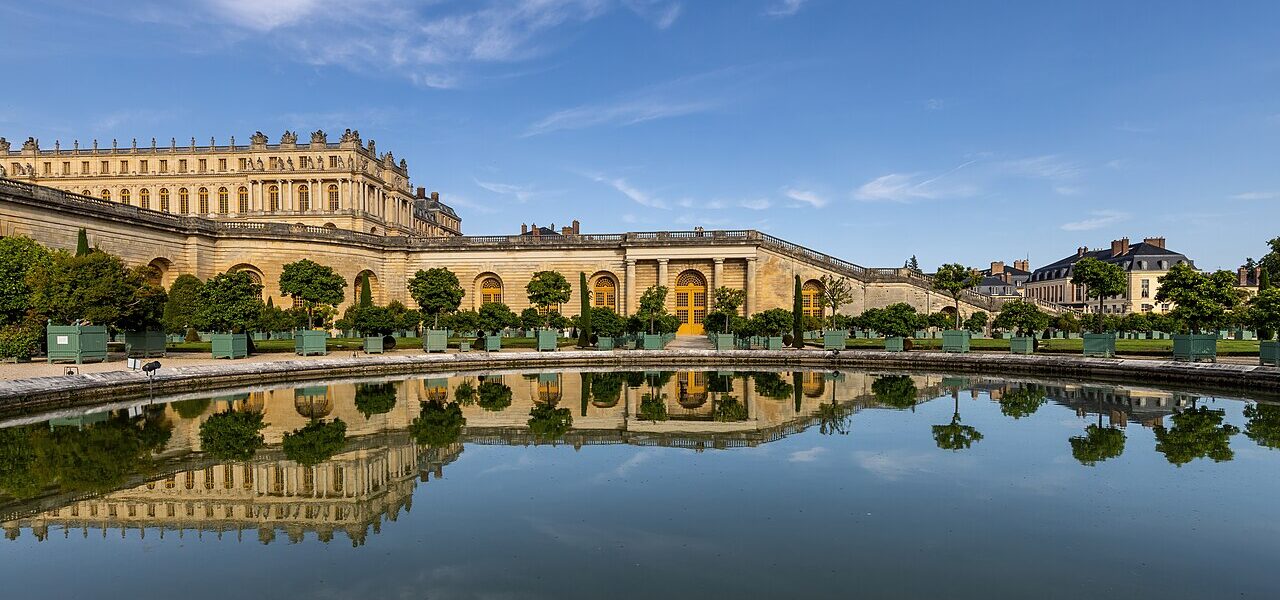
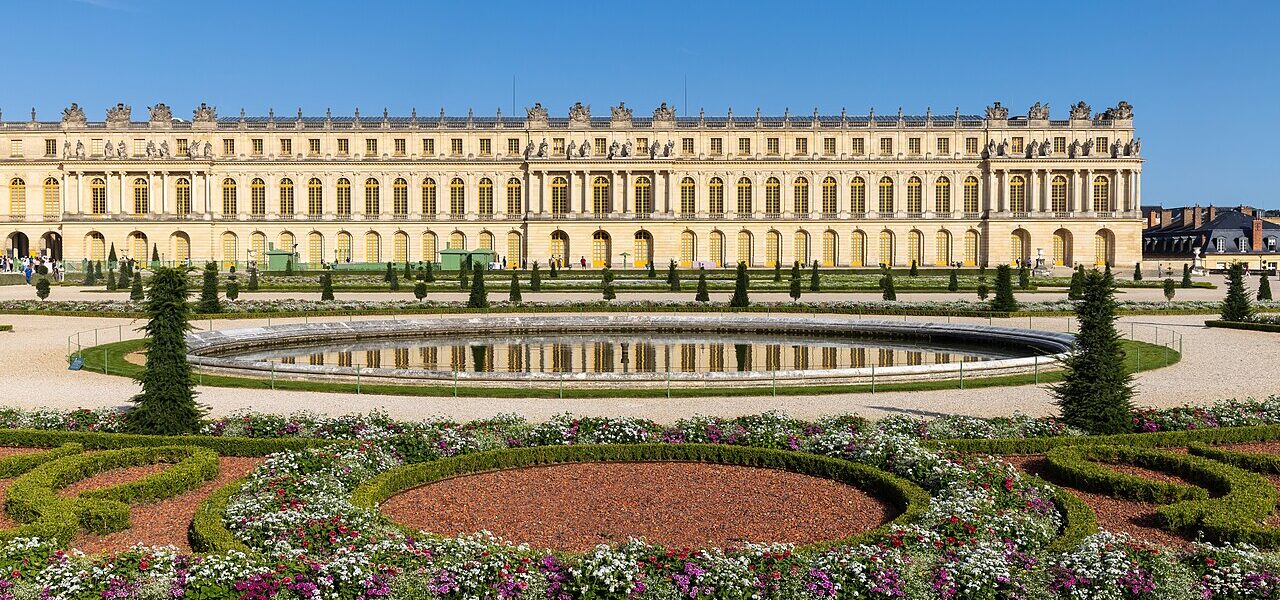
If the palace interior is the work of Versailles’ architects, the gardens are the creation of André Le Nôtre, the greatest landscape designer in French history. Stretching over 800 hectares, the formal gardens present nature entirely subjugated to human design: perfectly clipped hedges, geometric parterres of colourful flowers, gravel paths aligned on the axes of the sun, and spectacular fountains powered by an extraordinary hydraulic system.
The Grand Canal — a cross-shaped artificial lake 1.6 kilometres long — reflects the sky and the distant facade of the palace in its still waters. Beyond the formal gardens, the naturalistic English-style gardens and the woods of the Grand and Petit Trianon offer a different, more intimate experience of Versailles.
Royal History and Revolution
Versailles was the seat of the French government from 1682 until 1789, when the French Revolution forced Louis XVI and Marie-Antoinette to abandon the palace and return to Paris — a departure that would lead directly to their executions. The palace was subsequently stripped of much of its furniture and art, and fell into decay before Napoleon and later Louis XVIII began its restoration.
In 1919, Versailles entered modern history when the Treaty of Versailles, formally ending the First World War, was signed in the Hall of Mirrors — giving the room an additional layer of historical significance that complements its original glory.
Planning Your Visit
The Palace of Versailles receives over 10 million visitors per year, making it one of the most visited monuments on Earth. Book tickets well in advance, especially for summer visits. The palace itself, the Grand Trianon, and the Petit Trianon are all accessible with different ticket combinations. The gardens are free to enter on most days, though there is a charge on the spectacular Grandes Eaux Musicales days when the fountains run to classical music. Allow a full day for a thorough visit.
Key Facts
| Built | 1661-1710 |
|---|---|
| Style | French Baroque |
| Rooms | 2300 |
| Region | Ile-de-France |
| Entry | 20.00 |
| Open | 9:00-18:30 (Apr-Oct) / 9:00-17:30 (Nov-Mar) |
| UNESCO | World Heritage Site |